
 |
The Peel Web |
I am happy that you are using this web site and hope that you found it useful. Unfortunately, the cost of making this material freely available is increasing, so if you have found the site useful and would like to contribute towards its continuation, I would greatly appreciate it. Click the button to go to Paypal and make a donation.
This document has been taken from the Victorian Web.
The story of the Seven Sleepers concerns young men who fell asleep and woke up years afterwards to find the world changed. It was told in Greek by Symeon Metaphrastes in his "Lives of the Saints" for the month of July, by Gregory of Tours in Latin and by James of Sarug (d. 521) as a Syriac version. From the Syriac, the story was translated into other Eastern languages. There are also a number of European versions.
According to Symeon Metaphrastes' story, Decius (249-251) went to Ephesus to enforce his laws against Christians and subjected them to a series of graphically described, gruesome horrors. He found seven young Christian noblemen - Maximillian, Jamblichos, Martin, John, Dionysios, Exakostodianos and Antoninos. The emperor tried them and then gave them a short time to consider what they would do. They gave their property to the poor, took a few coins only with them and went into a cave on Mount Anchilos to pray and prepare for death.
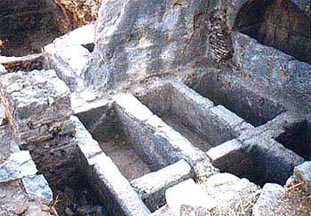 The
tomb of the Seven Sleepers on the northern slopes of Mount Pion near Ephesus
in Turkey
The
tomb of the Seven Sleepers on the northern slopes of Mount Pion near Ephesus
in Turkey
Decius came back after a journey and inquired after these seven men. They heard of his return and then, as they said their last prayer in the cave before giving themselves up, fell asleep. The emperor told his soldiers to find them: when they were found asleep in the cave Decius ordered it to be closed up and sealed. The seven young men effectively were buried alive but another Christian came and wrote on the outside the names of the martyrs and their story. Years passed, the empire became Christian and Theodosius [either the Great (379-395) or the Younger (408-450)] reigned. In his time some heretics denied the resurrection of the body. While this controversy went on, a rich landowner named Adolios had the Sleepers' cave opened, to use it as a cattle-stall.
The sleepers awoke, thinking they had slept only one night, and sent Diomedes to the city to buy food, so that they could eat before they gave themselves up. Diomedes went into Ephesus and was amazed to see crosses over churches; the Ephesians could not understand from whence he got the money that had been coined in the reign of Decius. Eventually it was revealed that the last thing he had known was Decius' reign; the bishop and the prefect went to the cave with him, where they found the six others and the inscription. Theodosius was informed and the young men told him their story. Everyone rejoiced at this proof of the resurrection of the body. The sleepers then died, praising God. The emperor wanted to build golden tombs for them but they appeared to him in a dream and asked to be buried in the earth in their cave. The cave was adorned with precious stones, a great church was built over it and every year on 27 July the feast of the Seven Sleepers is kept.
| Meet the web creator | These materials may be freely used for
non-commercial purposes in accordance with applicable statutory allowances
and distribution to students. |
Last modified
4 March, 2016
|