|
1
|
|
|
2
|
- Who protested and why from 1815 – 1828?
- How much of revolutionary threat did they present to the government?
- What steps did the government take to deal with these protesters?
- What steps were taken at a local level?
|
|
3
|
|
|
4
|
|
|
5
|
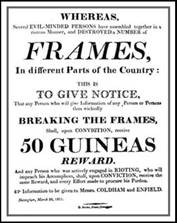
- Luddites were men who took the name of a mythical individual, Ned Ludd
who was reputed to live in Sherwood Forest.
- The Luddites were trying to save their livelihoods by smashing
industrial machines developed for use in the textile industries of the
West Riding of Yorkshire, Nottinghamshire, Leicestershire and
Derbyshire. Some Luddites were also active in Lancashire.
- They smashed stocking-frames and cropping frames among others.
|
|
6
|
- There does not seem to have been any political motivation behind the Luddite
riots.
- Nor was there any national organisation.
- These men were simply attacking what they saw as the reason for the
decline in their livelihoods.
|
|
7
|
- The only person who seems to have appreciated the problems faced by
ordinary people was the Earl Fitzwilliam, Lord Lieutenant of the West
Riding of Yorkshire.
- He said, 'outrage and conspiracy ... are the offspring of distress and
want of employment ... fostered and rendered formidable by nothing but
the want of trade'.
- Many of the radical leaders such as Major Cartwright and William Cobbett
criticised the Luddite violence as counter productive
|
|
8
|
- In February 1812 the government of Spencer Perceval proposed that
machine-breaking should become a capital offence.
- Despite a passionate speech by Lord Byron in the House of Lords,
Parliament passed the Frame Breaking Act that enabled people convicted
of machine-breaking to be sentenced to death.
- As a further precaution, the government ordered 12,000 troops into the
areas where the Luddites were active
|
|
9
|
|
|
10
|
- A group of radicals called the Spenceans led by Arthur Thistlewood decided
to use one of Henry Hunt's open air meetings at the Spa Fields in London
to attempt a coup.
- The Spenceans had planned to encourage rioting at this meeting and then
seize control of the British government by taking the Tower of London
and the Bank of England.
- During the riot a small group of protesters looted a gun shop but were
met by troops at the Tower of London & dispersed and arrested.
|
|
11
|
- The magistrates decided to disperse the meeting and while Stafford and
eighty police officers were doing this, one of the men, Joseph Rhodes
was stabbed.
- The leaders of the Spenceans, James Watson, Arthur Thistlewood, Thomas
Preston, John Hooper were arrested and charged with high treason.
- The authorities were tipped off about their plot by a government spy.
|
|
12
|
- The government had become very concerned about this group and employed a
spy, John Castle, to join the Spenceans and report on their activities.
- He was used as the main witness in the trial of James Watson.
- However, the case was dropped against them after the defence council was
able to show that Castle had a criminal record and that his testimony
was unreliable.
- The jury concluded that Castle was an agent provocateur (a person
employed to incite suspected people to some open action that will make
them liable to punishment) and refused to convict Watson.
- The government responded by passing two new laws which banned unlawful
assemblies and suspended the Habeas Corpus Act.
|
|
13
|
|
|
14
|
- On the 10th March 1817, unemployed and starving cotton
weavers in Manchester led by John Johnson, decided to march to London to
present their grievances in a petition to the Prince Regent.
- They were protesting at losing their jobs, the suspension of Habeas
Corpus Act and the Seditious Meeting Act.
- They cleverly organised their march so that they would only have small
groups of protesters so that they wouldn't be breaking the law.
|
|
15
|
- On March 6th, 1817, Johnson told the marchers: 'If your leaders could
get you as far as Birmingham, the whole would be done, for I have no
doubt you would be 100,000-strong. Then, gentlemen, it would amount to
an impossibility to bring anything to resist you.'
- As they planned to sleep rough, the marchers were to carry rolled up
blankets or overcoats on their shoulders, to keep them warm at night.
They were quickly dubbed "The Blanketeers."
- The protest was mainly peaceful carried out in a legal fashion in
defiance of the new government legislation.
- Drummond urged the marchers to behave with decorum while Bagguley warned
that anyone causing trouble would be handed over to the magistrates.
|
|
16
|
- 10,000 people turned up at St Peter's field to see the Blanketeers off.
- This frightened the local magistrates who read out the Riot Act and sent
in the King's Dragoon Guards to arrest the leaders.
- In the confusion some of the Blanketeers set off.
- When the magistrates realised this, they despatched soldiers and special
constables to go after them.
- One group was stopped about a mile out of the city, while the main group
was hunted down at Lancashire Hill at Stockport.
- The military weighed into the marchers with sabres and muskets. Several
were wounded, one cottager, just happening to be in the wrong place at
the wrong time, was shot dead as he watched from his doorstep. Several
hundred men were arrested.
|
|
17
|
- A few of the Blanketeers struggled on as far as Macclesfield and even
Ashbourne in Derbyshire, but only one - Abel Couldwell of Stalybridge -
made it to London.
- He was allowed to hand over his
petition to the Prince Regent.
- Technically the Blanketeers had not broken any laws so the authorities
eventually released and sent them home.
|
|
18
|
- In May 1817 Brandreth met William Oliver from London. Oliver claimed
that a large group of Radicals were planning an armed uprising in London
on 9th June and asked Brandreth to persuade local workers to join the
rebellion.
- This was untrue and it is now believed that Oliver was working as an agent
provocateur for Lord Sidmouth, the Home Secretary.
- Oliver had previous been involved in helping to stop the Spa Fields
Rioters from capturing the Tower of London.
|
|
19
|
- On 9th June, Jeremiah Brandreth, led 300 men on a march on to attack and
seize Nottingham Castle which had been nicknamed the Bastille of the
north.
- Armed with a few pistols and pikes, Brandreth expected others to join
him on the way to the city.
- This did not happen and the local authorities had little difficulty
dispersing the proposed insurrection.
|
|
20
|
- Thirty-five of the men were charged with high treason. Brandreth and two
others were sentenced to death and another eleven men were transported
for life. The men were originally sentenced to being hanged, drawn and
quartered, but the quartering was remitted.
- On the scaffold one of the men shouted out that they were victims of Lord
Sidmouth and Oliver the Spy.
|
|
21
|
- On 16 August 1819, a crowd estimated at around 60,000 gathered at St
Peter's Fields in Manchester.
- They had come to hear Henry Hunt's speech in favour of reform and end to
the corrupt Parliamentary system.
- The evening before the event, large numbers of protesters had taken part
in military style parade ground drill.
- The Home Secretary, Lord Sidmouth, had urged the authorities to let the
protest go ahead rather than risk the consequences of a riot if it was
banned.
|
|
22
|
- As a direct result of the Blanketeers' March, the Manchester magistrates
decided that they needed a military force of their own to deal with
civil unrest.
- They formed the Manchester and Salford Yeomanry - and it was this
ill-trained collection of sabre-wielding shopkeepers and tradesmen.
- The Manchester JPs did not have any other means of administering
peaceful, effective civil law and order.
- On August 1819, the JPs frightened by the large crowds ordered the
Yeomanry to charge into the crowd with sabres drawn to disperse it and
arrest its leaders!
- When the crowd saw the sabres they panicked and stampeded
|
|
23
|
|
|
24
|
- The 'charge' or 'massacre' at Peterloo caused massive public outrage.
- Anger swept the country and was unjustly directed at the government.
- Meetings in many towns demanded that the Prince Regent dismiss Lord
Liverpool's cabinet.
- The government responded with the controversial Six Acts which attempted
to clearly define the powers of local government and the JPs.
- Some historians believe that the Six Acts were repressive, whilst others
believe that they were a sensible response and not unlike our
anti–terrorism laws today.
|
|
25
|
|
|
26
|
- Training Prevention Act: Any
person attending a gathering for the purpose of training or drilling
liable to arrest. People found guilty of this offence could be
transported for 7 years.
- Seizure of Arms Act: Gave power
to local magistrates to search any property or person for arms.
- Seditious Meetings Prevention Act: Prohibited the holding of public
meetings of more than fifty people without the consent of a sheriff or
magistrate.
- Misdemeanours Act: Attempted to reduce the delay in the administration
of justice.
- Blasphemous and Seditious Libels Act: provided much stronger
punishments, including banishment for publications judged to be
blasphemous or seditious.
- Newspaper and Stamp Duties Act: Subjected certain radical publications
which had previously avoided stamp duty by publishing opinion and not
news, to such duty.
|
|
27
|
|
|
28
|
- The Peterloo Massacre in Manchester increased the amount of anger that
many radicals felt towards the government.
- At one meeting a spy reported that Arthur Thistlewood said: "High
Treason was committed against the people at Manchester. I resolved that
the lives of the instigators of massacre should atone for the souls of
murdered innocents."
- 27 conspirators planned to assassinate key members of the cabinet when
they met at Lord Harrowby's for dinner on 22 February 1820.
|
|
29
|
- Lord Sidmouth was informed of the plot by one of his spies.
- He ordered Richard Birnie, a JP to arrest the conspirators using police
officers and if necessary soldiers from the Coldstream Guards.
- Birnie decided to arrest the conspirators using just 12 police officers.
- When they stormed the loft where they were meeting they shouted: 'We are
peace officers. Lay down your arms.'
- Arthur Thistlewood and William Davidson raised their swords while some
of the other men attempted to load their pistols.
- One of the police officers, Richard Smithers, moved forward to make the
arrests but Thistlewood stabbed him with his sword. Smithers gasped,
"Oh God, I am..." and lost consciousness. Smithers died soon
afterwards.
- Some of the gang surrendered but others like William Davidson were only
taken after a struggle.
- Four of the conspirators, Thistlewood, John Brunt, Robert Adams and John
Harrison escaped out of a back window but where later caught
|
|
30
|
|
|
31
|
- Learning from his previous mistakes Lord Sidmouth decided not to use the
evidence of his spies in court.
- 11 men were charged but 2 of them were offered a pardon in exchange for
giving evidence against their leaders.
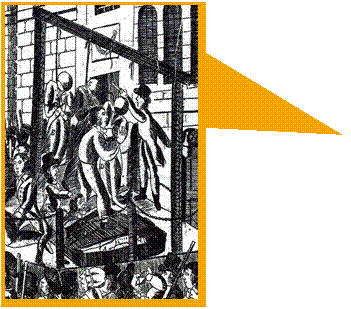
- Thistlewood, Davidson, Ings, Tidd and Brunt were executed at Newgate
Prison on the 1st May, 1820.
- The rest had their death penalties commuted to life transportation.
|
|
32
|
|
|
33
|
- George, Prince of Wales, was prevailed upon to marry his cousin Caroline
of Brunswick.
- As his part of a deal, parliament promised to pay off his enormous
debts.
- However, George had already married Maria Fitzherbert, a Roman Catholic widow;
however, the marriage was void in accordance with the terms of the Royal
Marriages Act of 1772.
|
|
34
|
- The Prince Regent, later George IV was very unpopular with the people
and was seen as a waster of public money.
- In 1820 he demanded that Lord Liverpool's government should get
Parliament to grant him a divorce.
- Caroline was determined not go without a fight and very popular with the
public.
- Riots erupted right across the country, including London in support of Caroline
- Lord Liverpool's bill was kicked out of Parliament and it looked like
the Prince Regent would dismiss the cabinet.
|
|
35
|
- When King George III died in 1820 matters came to ahead.
- Princess Caroline threatened to turn up to the coronation at the head of
a crowd and demand to be crowned queen.
- Lord Liverpool ended the crisis by paying her off with £50,000.
- Lord Sidmouth was also forced to resign as Home Secretary.
- Unfortunately, Prince Caroline didn't live long to enjoy her cash and
died two months later.
|
|
36
|
|

 Notes
Notes